Attic Ventilation Requirements: What Every Fort Worth Homeowner and Home Buyer Needs to Know
If you own a home in Fort Worth or you’re shopping for one in North Texas, attic ventilation might not be the first thing on your mind. But it’s one of the most important factors affecting your roof’s lifespan, energy bills, indoor air quality, and even the risk of hidden moisture damage.. Poor attic ventilation is a frequent finding during home inspections—and it’s one that can lead to high energy bills and expensive repairs if ignored.
At Fisher Home Inspections, we see the real-world impact of attic ventilation issues every week. Whether you’re a first-time buyer reviewing inspection reports or a longtime homeowner maintaining your property, understanding the requirements for attic ventilation can help you protect your biggest investment.
Why Proper Attic Ventilation Matters in Texas
Texas summers are hot and humid, and winters can bring sudden temperature swings. Without adequate ventilation:
Heat and moisture get trapped in the attic, raising cooling costs and stressing your HVAC system.
Moisture from everyday household activities (showers, cooking, laundry) can condense on roof sheathing, leading to wood rot, mold, or fungal growth.
Insulation can become compressed or displaced, reducing its effectiveness.
In extreme cases, poor ventilation shortens shingle life and contributes to premature roof failure.
Recent building science research actually suggests that in warm, humid climates like ours, conditioned (unventilated) attics can sometimes perform better than traditional vented attics because they keep conditioned air from leaking into the attic space.
Key Attic Ventilation Requirements from the Code (IRC R806)
Here’s a clear breakdown of the most important rules every homeowner and buyer should know:
Ventilate attic spaces unless you specifically design and build the attic as a conditioned (unventilated) assembly. This applies to attics above both conditioned and unconditioned areas.
Provide ventilation to each rafter bay when ceilings are installed directly to the rafters or truss top chords (common in cathedral or vaulted ceilings).
Protect all ventilation openings from rain, snow, and critters (birds, rodents, insects).
Minimum opening size: Ventilation openings must be at least 1/16 inch but no larger than 1/4 inch. Larger openings must be covered with corrosion-resistant wire mesh, hardware cloth, or similar material with openings between 1/8 inch and 1/4 inch.
Insulation clearance: Maintain at least 1 inch of clear space between insulation and roof sheathing. Never cover ventilation openings with insulation.
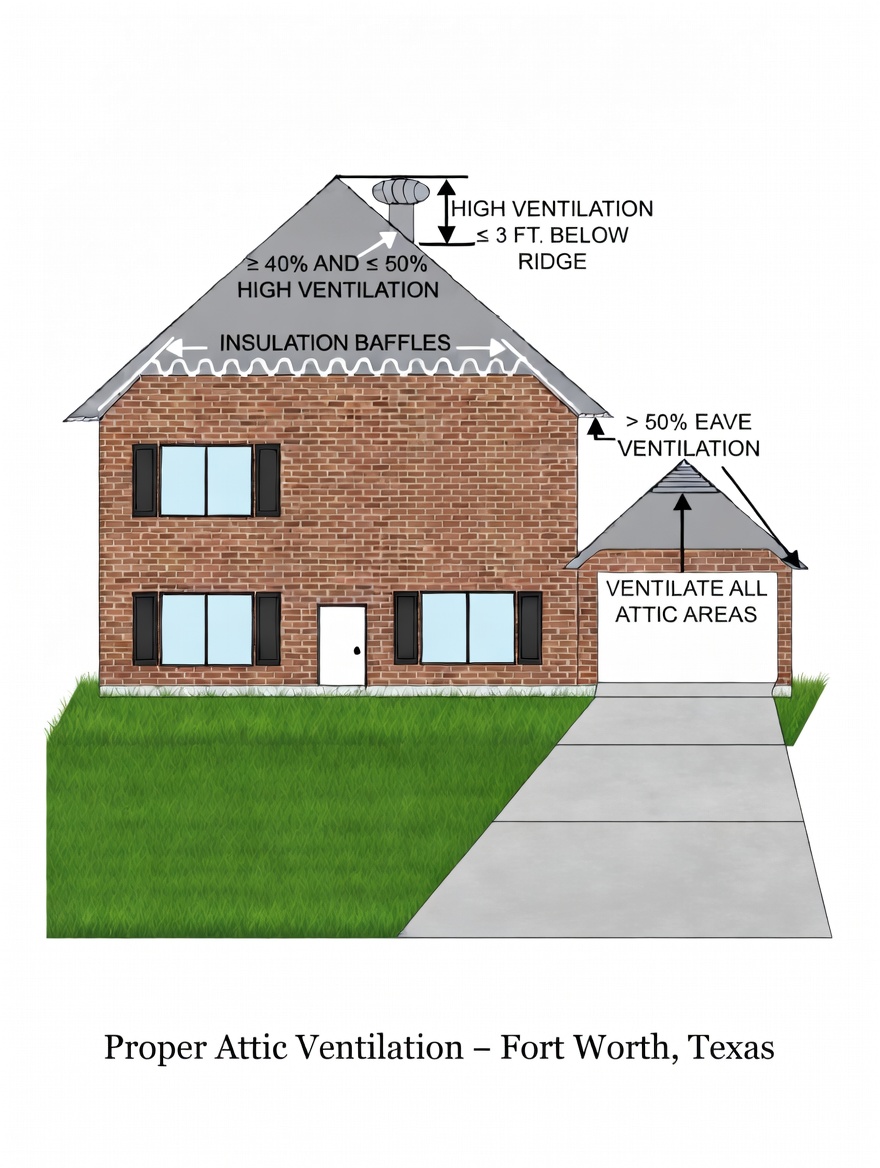
Net free ventilation area: The most common rule of thumb is 1 square foot of net free ventilation area for every 150 square feet of attic floor area (1:150 ratio). You can reduce this to 1:300 if:
At least 40% (but no more than 50%) of the ventilation is high (near the ridge), and
A balance of ventilation openings in the bottom third of the attic
Balanced airflow is best: Place vents high (ridge or gable) and low (soffit/eave) to create natural convection—hot air rises and exits while cooler air enters below.
How to Calculate the Right Amount of Ventilation (Real-World Examples)
2,100 sq ft single-story home with 600 sq ft attached garage: Minimum net free ventilation = 18 sq ft (1:150 ratio) or 9 sq ft (1:300 ratio, more common). Openings should be split evenly between the house and garage attics if they’re separated.
1,800 sq ft two-story home with 300 sq ft garage: Each floor is roughly 900 sq ft, so total ventilation is calculated separately for the main attic and garage attic. Aim for at least 7 sq ft in the main house attic and 1–3 sq ft in the garage attic.
Pro tip: Screens and louvers reduce the “net free” area. Metal louvers typically provide about 75% net free area; wood louvers only about 25%. Always check manufacturer specs.
Vented vs. Conditioned (Unventilated) Attics
Traditional vented attic (most common in older Fort Worth homes):
Uses soffit vents, ridge vents, or gable vents + baffles to keep insulation from blocking airflow.
Conditioned (unventilated) attic (increasingly popular in new construction):
The entire attic is sealed and brought inside the building’s thermal envelope. This requires:
Proper air sealing of the attic floor.
Proper ventilation in the attic space (this can be frequently missing)
Often spray foam or rigid board insulation applied directly to the underside of the roof deck.
In North Texas (Climate Zones 2A–3A), building science shows conditioned attics can reduce energy loss and prevent condensation issues caused by humid outdoor air meeting cool attic surfaces when constructed properly.
Attic Ventilation Best Practices & Common Home Inspection Findings
During every home inspection we check for:
Blocked or painted-over soffit vents
Missing or compressed baffles (cardboard or foam baffles keep insulation out of the ventilation channel)
Insufficient net free area
Ventilation in conditioned attics
Improperly installed ridge vents or turbine vents
Evidence of past moisture (stains, mold, warped sheathing)
Quick homeowner tip: Use cardboard or foam baffles between rafters to maintain that critical 1-inch airflow channel. And if you’re having your house painted, ask painters to mask soffit vents—paint buildup is a surprisingly common problem.
Bottom Line: Get Your Attic Checked
Proper attic ventilation (or the correct unventilated conditioned attic design) is one of the smartest, most cost-effective ways to protect your roof, improve energy efficiency, and maintain healthy indoor air quality—especially here in the humid DFW climate.
Whether you’re buying a home in Fort Worth, Arlington, Keller, or anywhere in the DFW area, make sure attic ventilation is on your inspection checklist.
Need a Home Inspection?
Schedule a professional home inspection with Fisher Home Inspections today. We’ll give you a clear, easy-to-understand report on your attic’s ventilation, insulation, and overall condition—so you can make confident decisions about your home.
Residential Code References
The attic ventilation standards listed above are from R806 of the International Residential Code (IRC) 2021.