Grading and Drainage: Protecting Your Fort Worth Home from Costly Water Damage
As a homeowner or potential home buyer in Fort Worth, Texas, you already know the importance of a solid roof, reliable HVAC, and sturdy foundation. But one critical factor that often gets overlooked until problems appear is proper grading and drainage around your house. Poor grading and drainage is a common issue uncovered during professional home inspections—and they can lead to expensive foundation repairs, wood rot, and even termite damage if left unchecked.
In this guide, we’ll break down exactly what grade and drainage mean, why they’re essential for protecting your home (especially in the expansive clay soils common across DFW), and the red flags every homeowner and buyer should watch for. Whether you’re buying your first home in Fort Worth or maintaining an existing property, understanding these site conditions can save you thousands in the long run.
What Is Grading and Drainage—and Why Does It Matter?
Grading refers to the slope of the ground around your home, while drainage is the system that directs water away from the foundation. Together, they divert water away from the foundation so it flows toward appropriate drainage points on or off your property.
Why is this so important? Water is one of the biggest threats to any home. When water pools near the foundation:
It can seep into crawl spaces or your home, damaging wood structural members, insulation, and finish materials.
Moist soil creates the perfect environment for fungal growth (mold) and wood-destroying organisms like termites.
Water pressure against foundation walls causes cracks, bulging, rotation, lifting, or deterioration.
In colder months, freezing water leads to frost heave.
Expansive clays (very common in DFW) expand and contract with moisture, exerting massive pressure that can lift or sink your entire house.
Bottom line: Proper grading and drainage keep water away from your foundation and protect your biggest investment.
The Gold Standard: What “Good” Grading and Drainage Looks Like
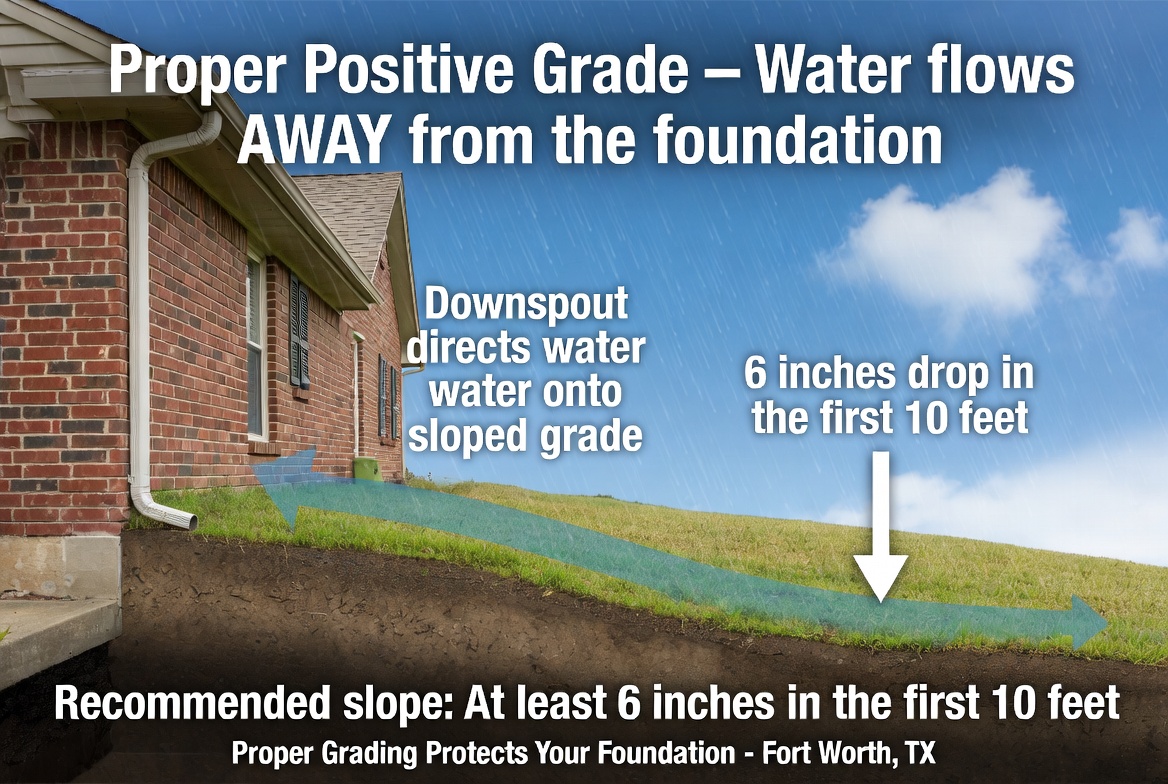
The ideal setup is a natural slope that carries water away from the house. Here are the widely accepted guidelines used by home inspectors:
Soil/earth should slope away from the foundation at least 6 inches in the first 10 feet.
Hard surfaces (concrete driveways, patios, sidewalks) should slope away at ⅛ to ¼ inch per foot (about a 2% slope).
These slopes ensure rainwater and irrigation water flow away quickly instead of pooling against the foundation. If the natural slope of your lot runs toward the house, a qualified builder or landscaper can install swales (shallow grass-covered channels) or re-grade the soil to redirect water safely.
Pro tip for buyers: During a home inspection, we always check these clearances.
Common Grading and Drainage Problems (and What They Look Like)
We see these issues frequently in Fort Worth inspections:
Negative grading — Dirt or concrete sloping toward the house instead of away from the house.
Flat or low-lying lots — Homes in low areas often experience flooding in crawl spaces or erosion around the foundation.
Downspouts dumping water too close — Gutters that empty right next to the foundation without extension or underground drainage.
Over-steep slopes — While rare, too much slope away from the house can cause landslides or soil erosion on hilly properties.
Photos from inspection reports often show obvious clues: puddles after rain, green algae on siding near the ground, mulch piled against the house, or garden hoses and downspouts directing water straight to the foundation.
Drainage Systems That Work When Natural Slope Isn’t Enough
Sometimes the land just doesn’t cooperate. That’s when these systems become essential:
French drains / underground drains — Perforated 4-inch corrugated plastic pipe (or older clay tile) buried in gravel that collects and redirects water. These are invisible from the surface, so many homeowners don’t realize they exist—or whether they’re still working.
Channel drains and catch basins — Used on driveways or patios to catch water and feed it into underground pipes.
Downspout connections — Properly tied into underground drains that exit at the street, a swale, or a creek.
Sump pumps — Occasionally used in exterior systems when water must be pumped uphill.
Action Steps for Homeowners and Buyers
After heavy rain, walk your property and look for pooling water near the foundation.
Keep the 6-inch rule — Maintain at least 6 inches of clearance between soil and siding.
Extend downspouts at least 5–10 feet away from the house or connect them properly to underground drains.
Avoid piling mulch or dirt against the foundation.
Protect Your Fort Worth Home Today
Water damage from poor grade and drainage is one of the most preventable yet expensive problems a home can face. By understanding these principles, you can catch small issues before they become major repairs.
Residential Code References
The grading and drainage standards listed above are from R401.3, R403.1.7 and R801.3 of the International Residential Code (IRC) 2021.