Understanding Electrical Grounding in Your Home: A Guide for Homeowners and Buyers
Electrical grounding is one of the most important—and least understood—safety systems in a home. When it works correctly, it helps protect people and equipment during electrical faults. When it doesn’t, the results can range from nuisance shocks to serious injury or fire.
This guide explains how grounding works, the main types of grounding electrodes, common installation requirements, and what home inspectors typically look for.
Why Grounding Matters
Electricity always seeks a path back to its source (usually the utility transformer). Under normal conditions, current flows through the hot (ungrounded) wires, does its work, and returns through the neutral (grounded) wire.
If a fault occurs—such as a damaged wire touching a metal pipe, appliance frame, or water line—the electricity will take any available path. Proper grounding and bonding give fault current a low-resistance path back to the source so that a circuit breaker or fuse can trip quickly and clear the problem.
Without an effective ground, that fault current may travel through a person, a copper water pipe, or other unintended paths.
Service Grounding Basics
At the main service, the neutral (grounded) conductor is connected to the grounding electrode system at or before the service equipment (main disconnect). This connection is typically made at the most accessible point because the meter enclosure is often locked or sealed.
Key rules include:
The neutral is bonded to the grounding electrode conductor at the service equipment.
Downstream of this point, the neutral and equipment grounding conductors are kept separate (except in specific multi-building situations).
All metal parts of the electrical system—panel enclosures, metal conduit, and certain metal piping systems—are bonded to the grounded (neutral) conductor so they remain at the same electrical potential.
Grounding Electrodes: The Connection to Earth
A grounding electrode is the physical connection between the electrical system and the earth.
Common types include:
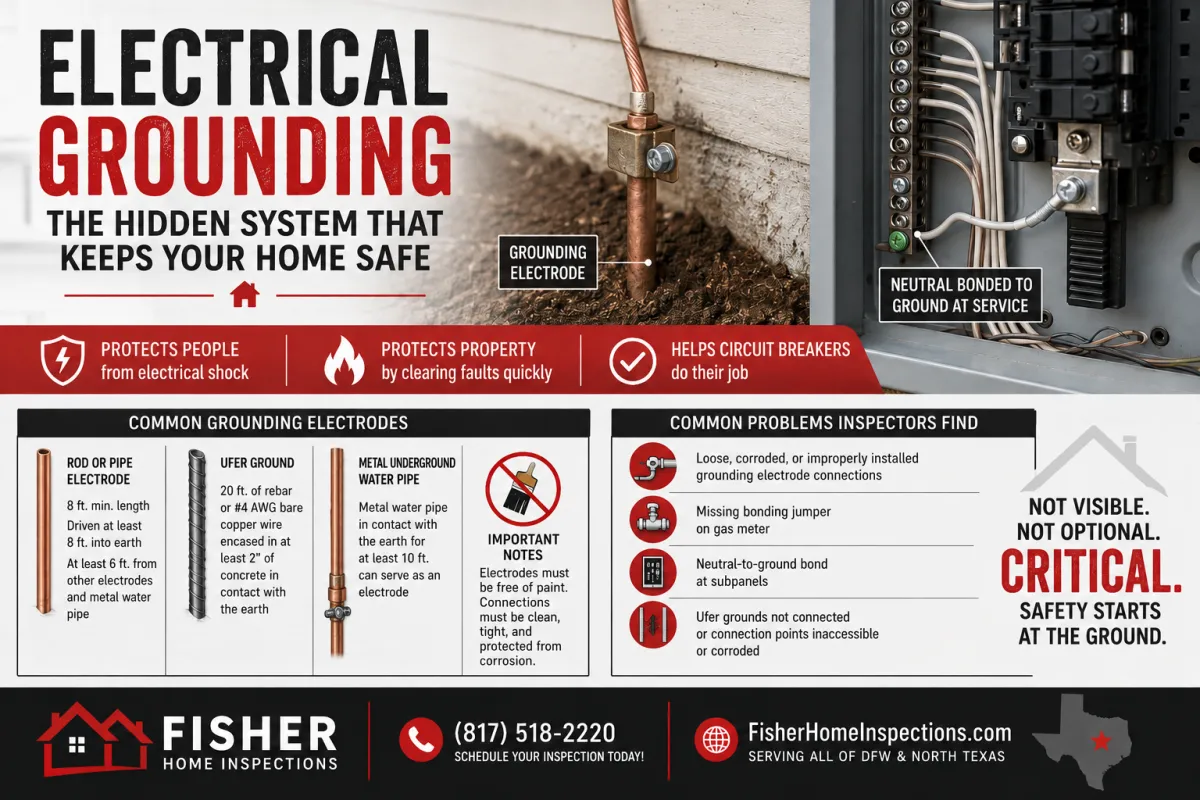
Rod and Pipe Electrodes (most common)
These are the most common supplemental electrodes. Requirements typically include:
Metal pipe or conduit at least ¾ inch in diameter and 8 feet long (galvanized or corrosion-resistant), or
Stainless steel, zinc-coated steel, or copper rod at least ⅝ inch in diameter and 8 feet long.
Driven at least 8 feet into the earth (or buried 30 inches deep if rock prevents driving).
Placed at least 6 feet from other electrodes and from underground metal water pipe.
Ufer Ground
This uses at least 20 feet of ½-inch reinforcing bar or #4 AWG bare copper wire encased in at least 2 inches of concrete that is in direct contact with the earth. It is often installed in the foundation before the concrete is poured. The connection point must remain accessible and protected from corrosion.
Metal Underground Water Pipe
A metal water pipe in contact with the earth for at least 10 feet can serve as an electrode.
Important installation notes:
Electrodes must be free of nonconductive coatings such as paint.
Connections must be clean, tight, and protected from corrosion.
The upper end of a rod or the connection point must remain accessible and properly protected.
Common Problems Found During Home Inspections
Inspectors frequently note:
Grounding electrode conductors that are loose, corroded, or connected on the wrong side of a clamp.
Missing bonding jumpers on gas meters.
Neutral-to-ground bonds at subpanels (where they should not exist).
Ufer grounds that were never connected or whose connection points are inaccessible or corroded.
Any of these conditions can reduce the effectiveness of the grounding system.
What Homeowners and Buyers Should Know
Grounding systems are not visible in everyday life, yet they are critical for safety.
Older homes may lack modern grounding electrodes or may have only a water-pipe electrode that has been compromised by plastic pipe repairs or water softeners.
Additions, detached buildings, and panel upgrades often reveal incomplete or outdated grounding.
A professional home inspection includes evaluation of the accessible portions of the grounding and bonding system. Some conditions (buried electrodes, foundation Ufer grounds) cannot be fully verified without specialized testing or excavation.
If you are buying a home, ask your inspector specifically about the grounding electrode system, the condition of bonding jumpers, and whether any subpanels have improper neutral-ground bonds. If you already own the home, periodic visual checks of accessible connections (clamps, panel bonding, water-pipe bonds) are worthwhile, especially after plumbing work.
Proper grounding and bonding give fault current a safe path home. When the system is complete and intact, circuit breakers can do their job and protect the people who live there.
Ready to schedule a home inspection?
Contact us today at (817) 518-2220 or book online at FisherHomeInspections.com. Whether buying, selling, or maintaining your current home, we’re here to help keep your family safe.
— Kyle Fisher, Professional Home Inspector
serving all of DFW and North Texas
Residential Code References
The grounding standards listed above are from E3607 and E3608of the International Residential Code (IRC) 2021.