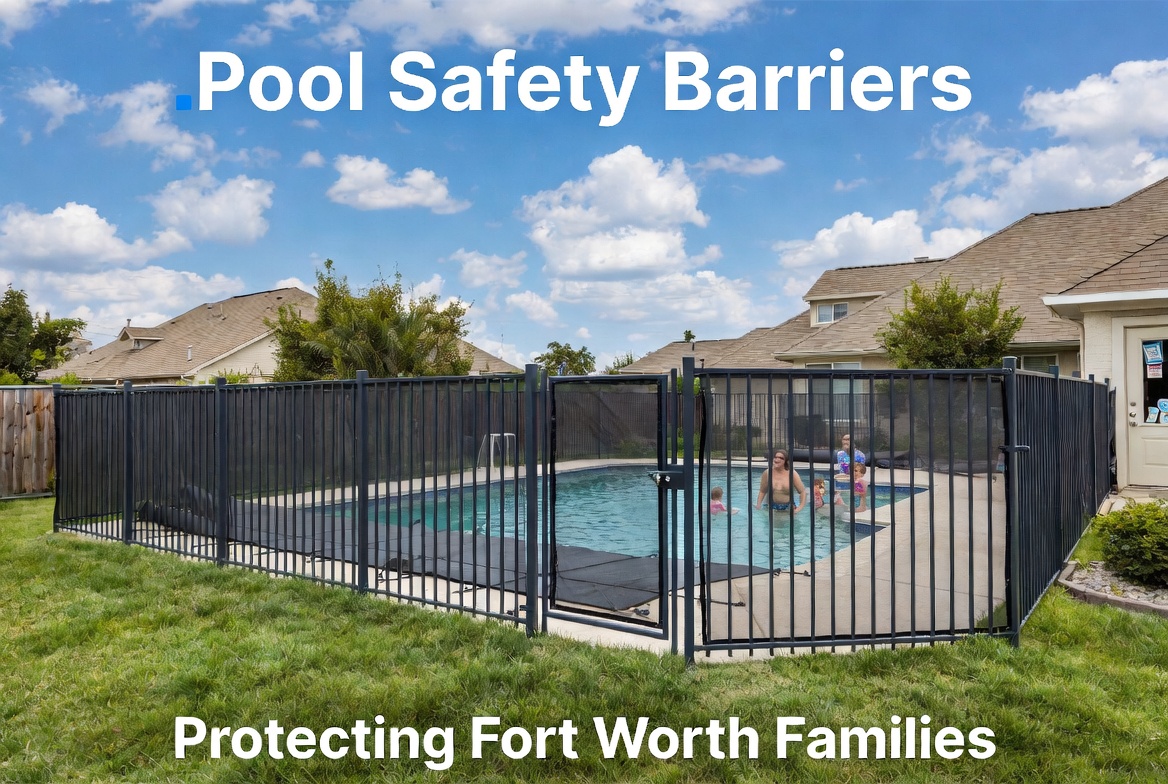
Pool Barrier Safety: What Fort Worth Home Owners and Home Buyers Need To Know
As a homeowner in Fort Worth or a prospective buyer eyeing properties with pools, pool safety should be a top priority. Texas summers are hot, and backyard pools are common in our area, but they also can present serious risks—especially to young children. According to the U.S. Consumer Product Safety Commission (CPSC), thousands of American families experience swimming pool tragedies each year, with the majority involving children ages 1 to 3 in residential settings. These incidents are preventable with proper barriers and safety measures.
At Fisher Home Inspections, we frequently evaluate pool areas during inspections. Our goal with pools is to help educate Fort Worth homeowners and home buyers on creating and maintaining effective pool barriers.
Why Pool Barriers Matter in Fort Worth
Drowning is a leading cause of accidental death for children under 5 in the U.S., and in warmer southern states like Texas, the risk is even higher. Barriers provide critical layers of protection when adult supervision momentarily lapses.
Key CPSC Statistics:
Nearly 300 children under age 5 drown in pools and spas annually.
Children ages 1–3 account for about 67% of reported pool fatalities.
Most incidents occur in family or relative-owned pools.
Over 4,100 young children require emergency room treatment for submersion injuries each year.
A proper pool safety barrier gives parents precious extra time to locate a wandering child.
Core Requirements for Pool Safety Barriers
According to CPSC guidelines, an effective barrier prevents a child from getting over, under, or through it while keeping the pool inaccessible without adult supervision.
1. Fence Height and Construction
The top of the barrier should be at least 48 inches above grade (measured on the side facing away from the pool).
Barriers must be designed to eliminate handholds or footholds that could help a child climb.
For solid barriers (like walls), avoid indentations or protrusions except for normal construction tolerances.
2. Spacing and Openings
Vertical members (pickets) should have no more than 1¾ inches of spacing to prevent a child from squeezing through.
For chain-link fences, mesh openings should not exceed 1¼ inches square (unless slats are used to reduce openings).
Decorative cutouts or lattice must also limit openings to 1¾ inches maximum.
Bottom clearance: Maximum 4 inches from the ground to the bottom of the barrier (reduced to 2 inches on non-solid surfaces like grass or gravel).
3. Gates – The Weakest Link
Gates are often the most vulnerable point.
All pedestrian gates must be self-closing and self-latching.
The release mechanism should be at least 54 inches from the bottom of the gate (or properly positioned high on the pool side).
Gates should open outward, away from the pool.
Maintain proper working order at all times—no gaps greater than ½ inch near the latch.
Special Considerations for Different Pool Types
Above-Ground Pools
These require barriers too. The pool structure itself can serve as part of the barrier if properly designed, but steps or ladders must be secured, locked, or removed when not in use. Alternatively, surround them with a compliant fence.
Portable Pools
Popular for their affordability, these still pose major risks. Never leave children unsupervised. The recommendation is to fence, cover, or empty and store them when not in use.
When the House Serves as a Barrier
Many Fort Worth homes have doors opening directly onto patios or pools. In these cases:
Install door alarms that sound loudly (at least 85 dBA) when doors open.
Consider power safety covers that meet ASTM F1346-91 standards.
Use self-closing/self-latching devices on doors.
Additional Layers of Protection
Barriers are essential but not foolproof. Combine them with:
Pool covers (maintained properly and with controls out of children’s reach)
Door and gate alarms
Anti-entrapment drain covers
Life-saving equipment (life rings, reaching poles) readily available
Constant adult supervision — barriers cannot replace attentive adults
What Home Buyers and Homeowners Should Do
For Home Buyers: During your home inspection in Fort Worth, request a thorough evaluation of any pool or spa barriers, gates, alarms, and covers. Identifying deficiencies early can prevent costly surprises after closing and help keep future occupants safe.
For Current Homeowners: Regularly inspect your pool barrier for damage, ensure gates latch properly, test alarms, and maintain covers. Update neighbors and caregivers about pool safety rules.
Pool safety saves lives. Install proper barriers, maintain them diligently, and never leave children unattended near water.
Need A Home Inspection
Contact us today at (817) 518-2220 or book online at FisherHomeInspections.com Whether you're buying in Fort Worth, Keller, Arlington, or surrounding areas, we're here to help you make informed decisions and create safer homes.
— Kyle Fisher, Professional Home Inspector
Keller, Texas
Sources: ASTM standards (ASTM F 1908-08, ASTM F 2286-05, ASTM F 1346-91). Also visit poolsafety.gov for more information on pool safety.