How to Maintain Your Retaining Wall and Avoid Costly Replacement
A retaining wall does more than hold back soil. It protects your foundation, prevents erosion, creates usable outdoor space on sloping lots, and can significantly affect your property’s value and safety. When a retaining wall fails, repairs or full replacement often run into thousands or tens of thousands of dollars. The good news is that most failures are preventable with regular attention and proper maintenance.
Whether you’re a current homeowner or a homebuyer evaluating a property, understanding how retaining walls work and what causes them to fail—can save you major headaches and expense.
What Is a Retaining Wall?
A retaining wall is a structure designed to hold earth or other fill on one side and keep it from moving beyond the wall. Homeowners commonly use them to stabilize slopes, create level areas for patios or gardens, and protect the home’s foundation from soil movement and water.
In a home inspection, retaining walls are typically evaluated to the extent that their failure could impact the house. But many inspectors, including us, examine most or all walls on the property because replacement is expensive and clients usually expect them to be checked.
Common Types of Retaining Walls
Retaining walls come in several materials, each with different strengths and limitations:
Landscape block / precast concrete – Popular and relatively easy to install. Height is often limited by the manufacturer (commonly around 2–3 feet without reinforcement).
Natural stone (rubble) – Attractive and durable when properly built, but requires skill.
Wood (landscape timbers or railroad ties) – Common but typically limited to about 4 feet in height in many areas. Preservative-treated wood rated for ground contact (UC4A or higher) is required. Service life is usually 10–20 years depending on drainage, soil conditions, and material quality.
Concrete masonry units (CMUs / concrete blocks) – Strong when properly reinforced and grouted, especially on taller walls.
Poured concrete – Very durable when reinforced and built on a proper footing.
Gabion walls – Wire cages filled with stone; less common in residential settings.
Walls taller than about 4 feet with no horizontal support at the top, or walls that support a lateral load (such as a driveway, building, or slope above), often require an engineer-approved design and a permit.
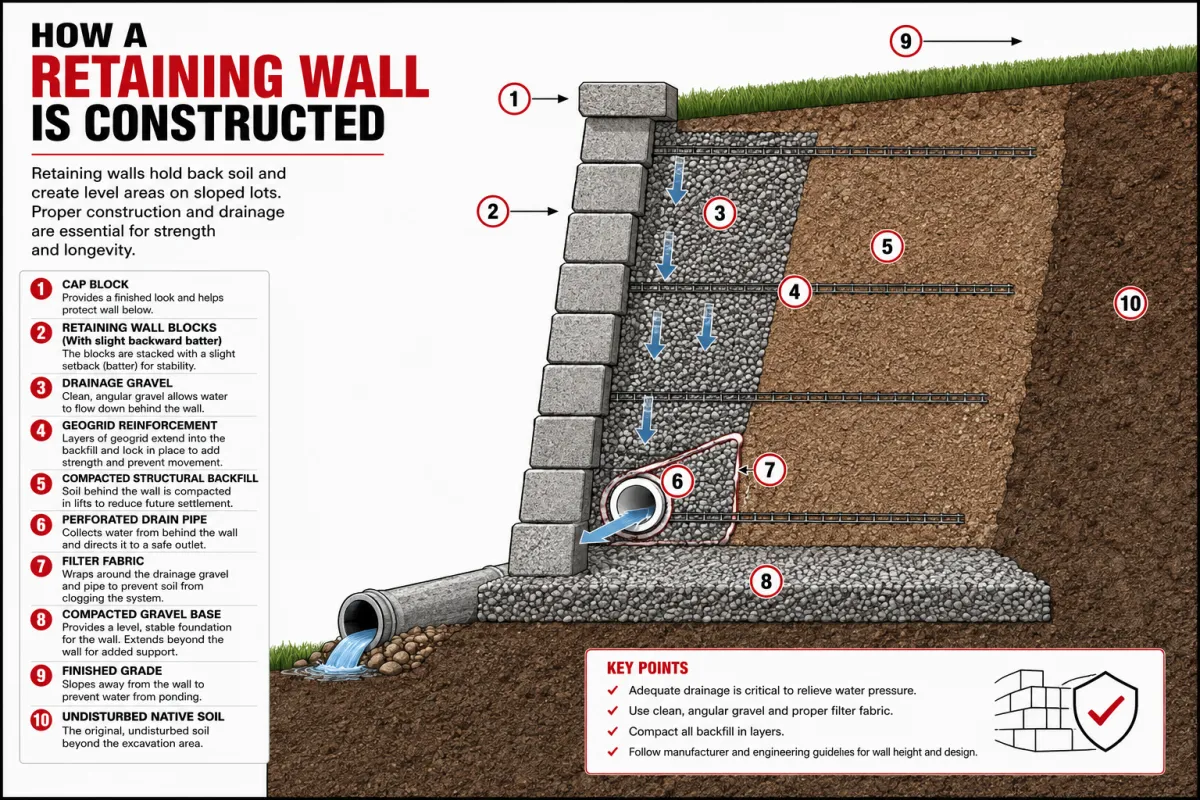
The #1 Cause of Failure: Poor Drainage
Water pressure behind a retaining wall is the most common reason walls lean, crack, bow, slide, or collapse. When water cannot escape, hydrostatic pressure builds. Freeze-thaw cycles (frost heave) make the problem worse.
Proper drainage typically includes:
Weep (drain) holes near the bottom of masonry and concrete walls
A layer of gravel covered by filter fabric directly behind the wall
Proper surface grading so water flows away from the wall
In some cases, a footing drain similar to those used around basements
Wood and rubble walls often drain through natural gaps between members, but they still need good surface drainage and free-draining backfill.
Practical Maintenance Tips to Extend the Life of Your Wall
Most retaining wall replacements can be avoided with consistent, simple care:
Inspect regularly Walk the wall a few times a year, especially after heavy rain or freeze-thaw cycles. Look for new cracks, leaning, bulging, separation between blocks or stones, or leaning posts/timbers.
Keep drainage working Clear debris from weep holes. Make sure downspouts and gutters discharge water well away from the wall. Avoid placing dense soil or clay against the back of the wall.
Control vegetation Tree and large shrub roots can displace or crack walls. Keep aggressive plants away from the structure and trim growth that traps moisture against the face of the wall.
Avoid adding extra weight Do not park vehicles, store heavy materials, or place large planters directly on top of or immediately behind the wall unless it was specifically designed for that load.
Address small problems quickly Loose blocks, minor cracking, blocked drains, or early leaning are far cheaper and easier to correct than a fully failed wall.
Watch the height and material limits Wood walls and many landscape-block systems have practical height limits. Exceeding those limits without proper engineering dramatically shortens service life.
Warning Signs a Retaining Wall May Be Failing
Visible leaning, tilting, or bowing
Horizontal or stair-step cracks
Bulging sections
Separation between blocks, stones, or timbers
Soil washing out from behind or beneath the wall
Standing water or consistently wet soil at the base
Rot, insect damage, or significant weathering on wood walls
Movement of nearby fences, steps, or pavement
If you notice any of these, have the wall evaluated promptly. Early intervention is almost always less expensive than waiting.
What Homebuyers and Homeowners Should Know
When buying a home, ask the inspector to specifically comment on any retaining walls. Note whether the walls appear to have proper drainage, whether they exceed recommended heights for the material used, and whether there are signs of movement or inadequate support. Request that any walls not fully accessible or outside the scope of the inspection be clearly identified in the report, along with a recommendation for further evaluation if needed.
For existing homeowners, schedule periodic professional inspections—especially if the wall is taller than a few feet, supports a lateral load, or is showing any of the warning signs listed above. An experienced home inspector can identify issues that are easy to miss and help you decide whether a structural engineer or qualified contractor is needed.
Final Thoughts
A well-built and properly maintained retaining wall can last decades. One that is neglected, poorly drained, overloaded, or built beyond the limits of its materials often fails far sooner—and at significant cost.
Regular visual checks, good drainage, and prompt attention to small problems are the most effective ways to protect your investment.
Have questions about a retaining wall on your property? We’re happy to help.
Ready to schedule a home inspection?
Contact us today at (817) 518-2220 or book online at FisherHomeInspections.com. Whether buying, selling, or maintaining your current home, we’re here to help keep your family safe.
— Kyle Fisher, Professional Home Inspector
serving all of DFW and North Texas
Residential Code References
The retaining wall standards listed above are from R404.4 of the International Residential Code (IRC) 2021.